
 Subscribe to
 Subscribe to our
 The use of bluetooth enabled “beacons” in retail environments is one of the growing trends in mobile commerce.
As with any new marketing-focused technology, the key question is always “what is the reach?”
A new release from beacon platform company inMarket shows that beacons seem to be reaching a critical mass of addressable consumers.
Beacons
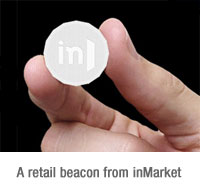 Beacons are small, BLE (Bluetooth low energy) devices that are able to connect with specific, partnered mobile apps when the smartphone comes in proximity. The beacon and the app communicate even if the app is closed and the phone is in the user’s pocket.
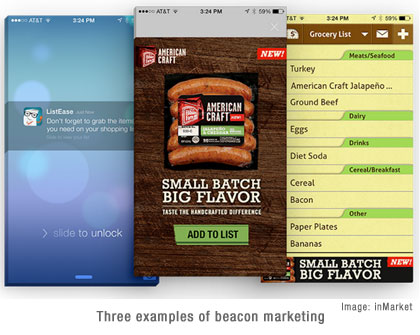
When the app receives a beacon signal, the app then wakes up and can provide a location-based mobile experience. This might be, for example, a welcome message when entering a store, a coupon, or a targeted mobile ad such as the examples shown below.
Millennials
Millennials are rapidly becoming the prime marketing target for many companies in the US. Although there doesn’t seem to be any consistently defined age span for Millennials, in general the group is defined as those people born between 1982 and roughly 2000.
 Millennials now represent the largest generation segment of the population, having recently passed the “Baby Boomer” group. There are approximately 83 million millennials in the US, of which 41 million are women.
This 15 to 32 year old demographic is very desirable for many marketers as they both have a lot of purchasing power in their own right (and it will be increasing), but they also tend to be the trendsetters which influence the other generational segments.
Millennial Moms and Beacons
Mothers tend to be one of the preferred segments of the millennial generation.
According to Todd Dipaola, CEO and founder of inMarket, “Millennial moms have become the most coveted part of the 18-34 demo due to their leadership role in family spending. Brands know they need to reach these mobile natives on the medium they use most intimately.”
 The latest study from inMarket shows that 38% of millennial moms are currently using mobile apps and “are reachable via beacon proximity engagements in stores every month.”
For all the women in the millennial generation, the reach of beacon technology is about 20%, significantly less than for mothers.
38% is quite an impressive figure given the newness of beacons, and it may be a good predictor of future potential. However, there are still some open questions as reach does not necessarily guarantee that these millennial moms are actually buying more as a result. Some case studies have shown strong increases in factors such as purchase intent or brand awareness which are very encouraging, though we will keep watching for reports of effects on actual sales.
| Tweet |
 del.icio.us
|

Subscribe to MobiAD | |

|

|
|
|
|
|
